The Original Jumbo: 5402 (1972-2002)
Gerald Genta designed the Royal Oak in a single night in 1972, and Audemars Piguet presented it at Basel that same year. The watch was a genuine provocation of the best kind: a luxury sports watch in stainless steel, priced far above anything else in that material, arriving without apology or explanation. That provocation produced, in physical terms, one of the most successful watch designs of the twentieth century.
It did not produce an immediate commercial success. The 5402 launched into a market that had no framework for a steel watch at roughly CHF 3,300, roughly five times what a comparable steel watch cost, and early sales were slow. AP had committed nearly the entire production run of its small manufacture to the Royal Oak, which made the initial indifference expensive. The watch found its audience gradually, through the mid-1970s, as the category it invented stopped needing explanation.

Audemars 5402 and 15202
The reference itself evolved through that period without changing its designation. Within the 5402, collectors now distinguish between the earliest examples, often called A-series, or serie A, and later production, based on subtle shifts in dial geometry, lume character, and more. These variations were not announced or directly catalogued by AP; they accumulated across years of small-batch production and are now the primary source of value differentiation within the reference.
Through the late 1970s and into the early 1980s, AP refined the execution of the 5402 without a fundamental structural revision. By the early 1980s and 1990s, transitional references had begun to appear.
The 5402 is 39mm across and 7.15mm thick. This piece was quite large for its era, earning the reputation of a 'Jumbo' model. The case sits against the wrist with no appreciable stack. The tapisserie dial, its small squares rendered elevating the dial, reads dark in shade and bright in direct light, the surface catching and releasing depending on angle. The applied indices are faceted and polished. The integrated bracelet, tapers from the case with extreme precision, creating one of the most beautiful and iconic designs.

Audemars Piguet 5402
Caliber 2121 powers the 5402. It is a result of both Audemars Piguet and Jaeger-LeCoultre, the base movement is JLC's 920, running at 19,800 vph with a 40-hour power reserve and about 247 parts. There is no quick-set date. The movement is 3.05mm thin by design, which is why the case can be 7.15mm while still running automatic.
The 14802 and 15202: The Reissue That Became Its Own Thing
While not a full production run of the model at scale, the first reintroduction of the Jumbo family within the Royal Oak line came in 1992 in the form of the 14802. The 14802 was a limited edition of 1000 examples made to celebrate the 20th anniversary of the Royal Oak. On this model, an exhibition caseback revealed the 2121 caliber in line with contemporary standards of movement visibility.
Then, on a more standard basis, Audemars Piguet reintroduced the Jumbo in 1999 as the 15202. By the time the 16202 arrived in January 2022 and the 15202 was discontinued, the market had realized the 15202 was a collector favorite.
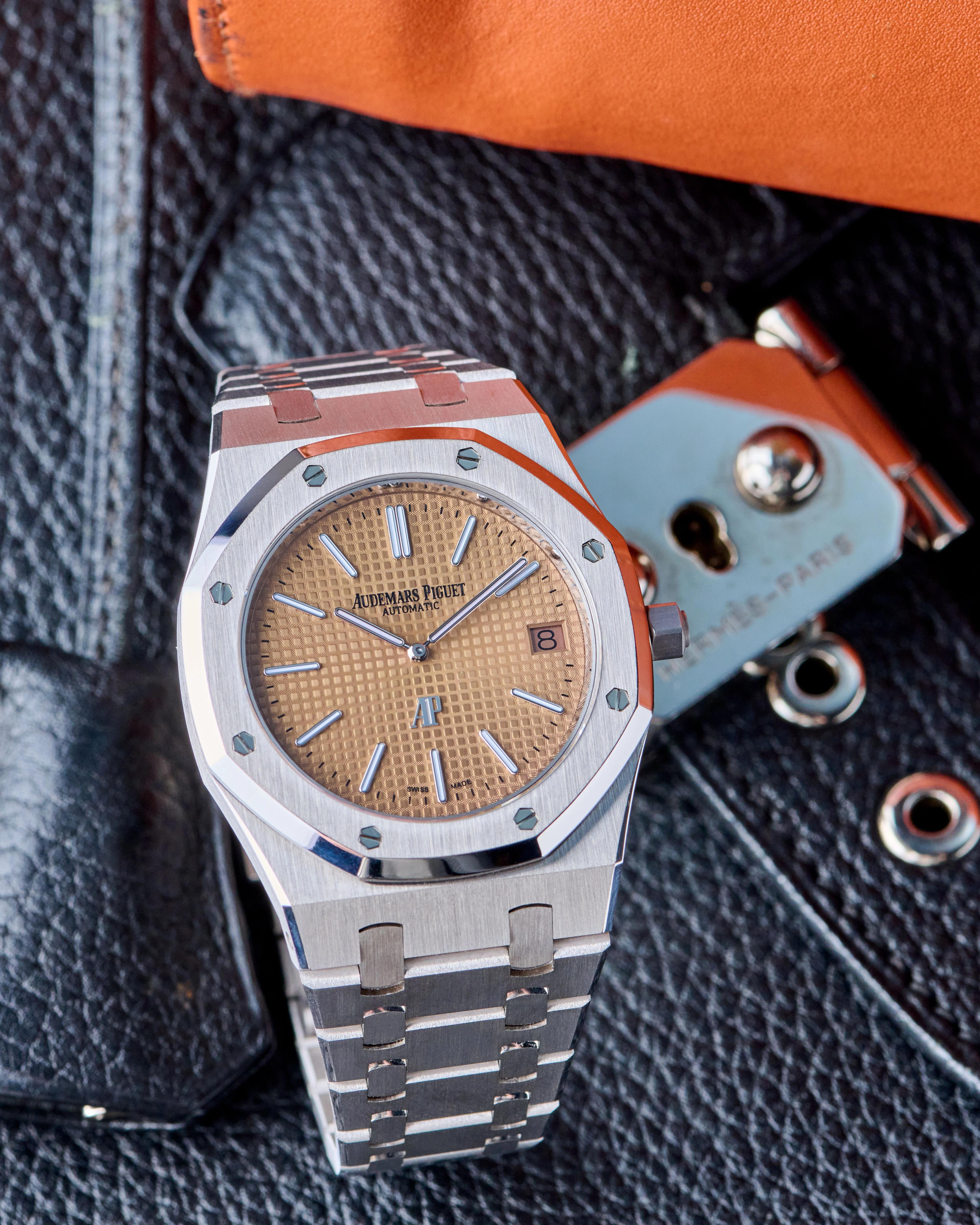
15202 Salmon
The 15202 carries the same cal. 2121 as the 5402. It is 39mm across, and the finishing precision AP brought to the later production run is tighter than what you find on most original Jumbo examples. The tapisserie dial is crisper, more dimensionally consistent. The bracelet integration is excellent. The 15202 made the Jumbo feel fresh, polished and sophisticated.
Production ran from 2000 to 2022, with AP announcing the discontinuation ahead of the 16202 debut. That announcement did what announcements like that always do: it created urgency, and prices followed. Ever since, the 15202 and 16202 have shared a similar wrist presence, with a slightly cheaper trade value on the 15202 affording a value opportunity for those chasing the aesthetic and feel of an ultra thin Jumbo.

Audemars Piguet 15202
The 16202 and the Current Era
Audemars Piguet launched the 16202 in January 2022 to open the Royal Oak's fiftieth anniversary year. The case held at 39mm and 8.1mm, same profile as the 15202. The movement was the big news on this reference.
Caliber 7121 is the first new Jumbo Royal Oak movement since 1972. The 2121 had served for fifty years without structural revision; the 7121 is genuine re-engineering rather than an update. It runs at 28,800 vph versus the 2121's 19,800. Power reserve extends from 40 hours to 55. Parts count goes from 247 to 268. The rotor now rides on ball bearings. Quick-set date is added. The movement is 29.6mm wide and 3.2mm thick, against the 2121's 28.4mm and 3.05mm, slightly larger in every dimension, but preserving the case at 8.1mm in thickness.

Royal Oak Anniversary 16202
The practical differences in wear are real: better winding efficiency, more reserve, faster date setting, which was a gripe with the 15202. The 7121 is a better caliber by almost all engineering measures. The 16202 remains the flagship ultra thin automatic Jumbo to this day.
Where the market sits on the 16202
The 16202 launched into a market running hot, and retail allocation was essentially unavailable at list. Pre-owned examples traded at significant premiums immediately following launch. Since the 2022 correction, that premium has compressed substantially. It remains one of the most desirable steel offerings on the market.
Beyond the Jumbo: The 15400, 15500, and the Self-Winding Line
The 41mm Royal Oak occupies a different market position entirely. It is cheaper to enter, it offers more dial and configuration variation, and it carries none of the Jumbo's collector mythology. That last point is not a criticism. It is a reason some buyers find the 41mm line more interesting rather than less.
The 15400 runs caliber 3120, Audemars Piguet's automatic that powered the reference for well over a decade. At 41mm, it is a physically different watch from the Jumbo, the proportions read differently on the wrist, with more presence in terms of diameter if not necessarily more weight. The 15400 is now out of production, succeeded by the 15500, and pre-owned values have settled into a range that represents genuine entry-level for the Royal Oak line in honest condition.

The 15500 replaced the 15400 and runs caliber 4302, which operates at 28,800 vph with a 70-hour power reserve, a meaningfully long reserve by any benchmark. The 15500 is 41mm, still in production, and has become the standard 41mm reference. The 15500 packs a more modern movement with a variety of enhancements, but sits a little thicker than the 15400 as a result. Buyers should weigh these factors to determine the correct watch for their application.
Complications in the Royal Oak Line
Chronograph: 26320 and 26331
Audemars Piguet upsized the Royal Oak Chronograph to 41mm with reference 26320. In 2017, a dial redesign produced the 26331, which replaced it. The 26331 remains in production and is the current-generation Royal Oak Chronograph, powered by caliber 2385, a column-wheel flyback that is well-regarded. Pre-owned 26331 examples in steel have held value more steadily than some time-only references through the correction, in part because the complication adds functional utility that holds appeal beyond pure collecting. The complicated market is a little insulated from the most volatile end of the market.

The 26320 and 26331 share the same case architecture; the dial is the primary distinguishing element. The 26331's dial is cleaner and more legible. For collectors focused on the arc of Royal Oak history, the 26320 is a less common reference, though not dramatically so.
Perpetual Calendar: 25820 and 26574
Reference 25820 is the Royal Oak Perpetual Calendar at 39mm, produced in 1,241 pieces between 1996 and about 2012. In the hierarchy of the Audemars line, this is a really rare reference, and represents one of the most significant in the evolution of the Royal Oak family. Market premiums on 25820 examples in good condition are real and defensible. Even so, collectors arguably don't value these pieces enough, considering the many variations that further subdivide the 25820s production into rarer sub buckets.

Reference 26574 brought the Royal Oak Perpetual Calendar to 41mm in 2015, powered by caliber 5134. The 26574, remains in production to this day. For buyers who are looking for an everyday wearable perpetual calendar complication in a sporty package, this is one of the best options on the market. For buyers who want the rarer piece with the history, the 25820 is worth the search and the premium.
What to Inspect Before You Buy
Refinishing is the primary value-killer. The Royal Oak's visual language depends on the contrast between its brushed and polished surfaces: flat facets on the case and bracelet links are brushed; bevels and edges are polished. When a watch is refinished without expert care, those distinctions blur. Brushed surfaces become partially polished; sharp edges soften. The result is a watch that looks fine in photographs and wrong in hand. EWC's experience across decades of Royal Oak transactions is that refinished examples are common often that refinishing is done wrong. Examine every surface under light at multiple angles. Soft edges and uniform surface texture are tells.

Bracelet stretch. The Royal Oak bracelet is among the most technically demanding integrated bracelets in the market and among the most worn parts of a used example. Owners adjust length, wear the clasp daily, and sometimes resize incorrectly. Check the clasp for play. Check each link for consistent movement. Check the lug ends where the bracelet meets the case, this junction is frequently stressed and shows wear before the rest of the bracelet does. A little play is very common, especially on older references, but make sure the tolerances are within a reasonable range.
Dial originality. On vintage and transitional references particularly, dial originality is not guaranteed. Redials, where a damaged or faded dial has been replaced, depress value significantly. Markers to check: lume consistency (aging should be uniform across all indices and hands), printing sharpness on date windows and text, and the character of the tapisserie itself, which should show consistent, fine geometry without evidence of overpainting or surface restoration.
The Royal Oak market rewards buyers who do the work. The correction that followed the 2020-2022 run-up has made real pieces available at real prices in ways that were not true a few years ago. The reference landscape is wide enough that a buyer at almost any budget above a certain floor can own a genuine Royal Oak in excellent condition. The question is which generation, which configuration, and whether the premium on any given example reflects the watch or the moment it was priced. If you have further questions about how to find the right piece for you, reach out to us!
Shop New Arrivals

Chronomaster Sport SS White Dial
$9,250
View Watch
Ferrari Sport Timer Titanium Black Dial
$4,950
View Watch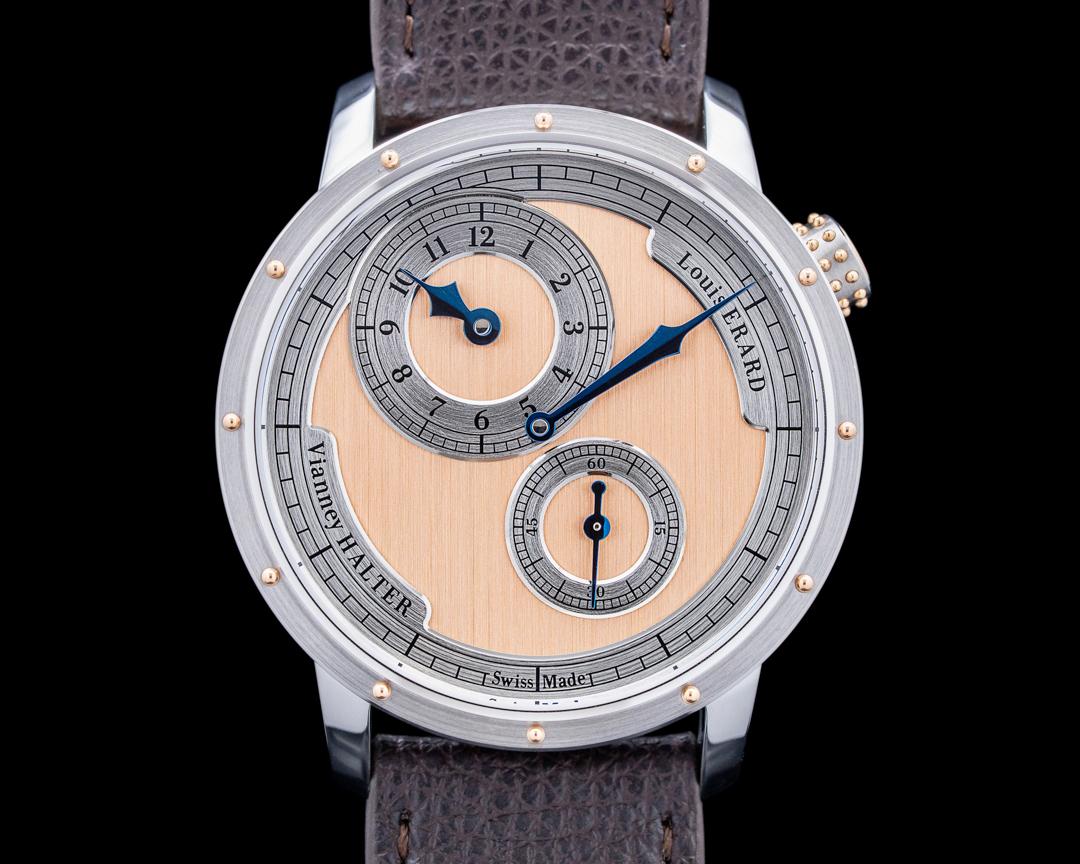
Le Regulateur x Vianney Halter II SS Gold and Silver Dial 2026 LIMITED
$6,900
View Watch
Pilot Chronograph Top Gun Lake Tahoe Ceramic Black Dial
$8,650
View Watch
Shop New Arrivals
Chronomaster Sport SS White Dial
$9,250
View WatchFerrari Sport Timer Titanium Black Dial
$4,950
View WatchLe Regulateur x Vianney Halter II SS Gold and Silver Dial 2026 LIMITED
$6,900
View WatchPilot Chronograph Top Gun Lake Tahoe Ceramic Black Dial
$8,650
View Watch
More Content