A Buyer's Guide to Pre-Owned Vacheron Constantin: What Each Line Actually Trades For
Published on 7/22/2026
If you are pricing a pre-owned Vacheron Constantin right now, the information available to you is thinner than it should be. Patek Philippe has a deep secondary market literature: price guides, reference breakdowns, condition analyses. A. Lange & Sohne has attracted serious collector writing that tracks individual references over time. Vacheron, despite sitting in the same tier, gets a fraction of that coverage. According to one dealer-analysis source, the brand attracts roughly 25% of Patek's online search volume, a statistic that maps to what any active dealer actually sees: buyers coming in with real money and noticeably less information than they'd bring to a Patek conversation.
That gap has consequences. Less signal means more noise. More noise means buyers either overpay because they anchored on retail, or they talk themselves into a project-condition watch because they couldn't find a clean comp. This piece tries to close that gap, reference by reference and condition grade by condition grade, using the same framework we've applied to Patek's perpetual and annual calendars.
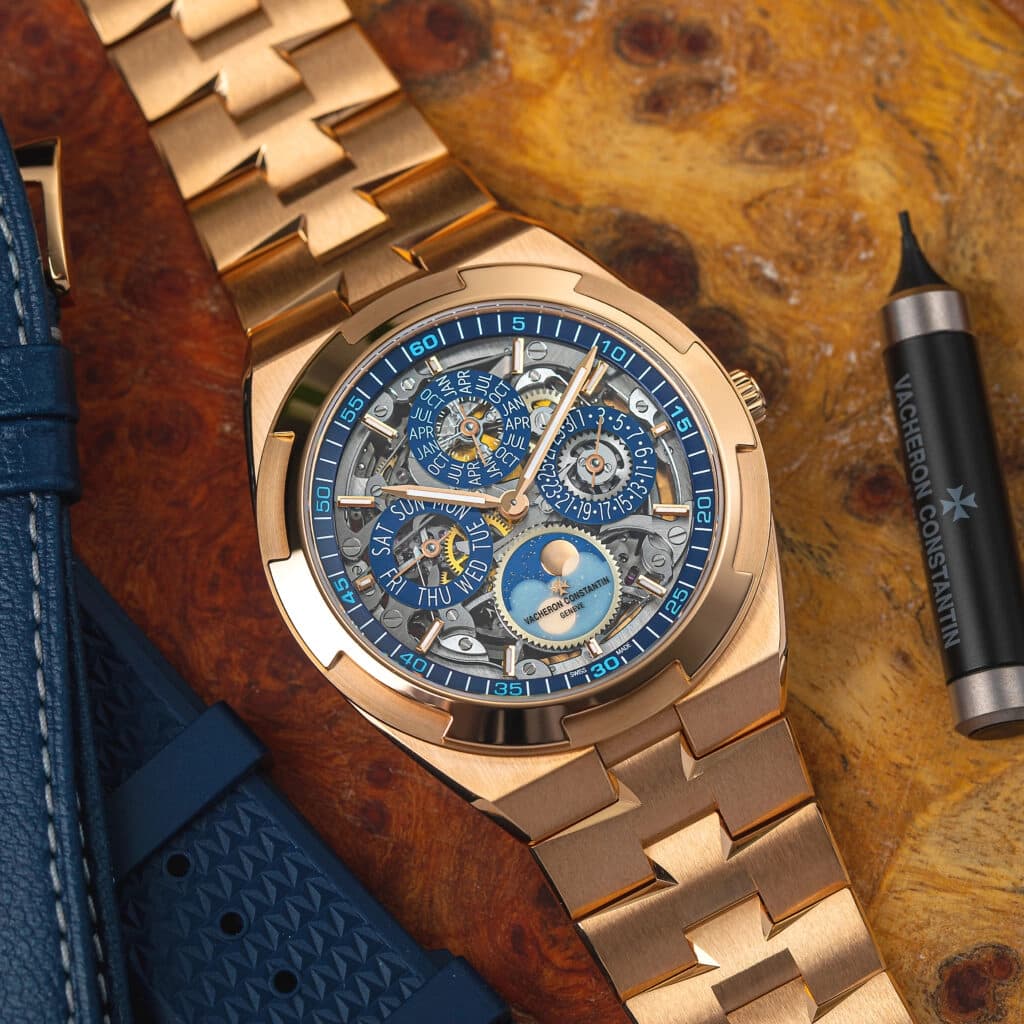
Overseas Perpetual Calendar Skeleton
One structural point before the pricing: Vacheron does not trade as a single curve. The Overseas line sits at or above retail on clean examples. Patrimony and Traditionnelle trade significantly below retail across most configurations. Historiques land somewhere in between, with meaningful variation by reference. Treating Vacheron as a monolith, "it holds value well" or "it's not Patek," misses the real picture. The line you're buying matters as much as the brand.
Why Vacheron Gets Less Coverage, and Why That's a Problem
The Holy Trinity framing, Patek Philippe, Audemars Piguet, Vacheron Constantin, has been useful shorthand for positioning conversations, but it has arguably done Vacheron a disservice in the secondary market. When buyers hear "Holy Trinity," many assume price behavior tracks uniformly across the three. It doesn't. When they discover that Vacheron trades differently than Patek, they often conclude the brand is somehow lesser rather than just different. The framing set an expectation the market doesn't always fulfill.
Secondary market coverage tracks liquidity, not prestige. Patek's Nautilus and Calatrava trade in volume large enough to support genuine price discovery: auction results stack up, dealer comps are abundant, condition premiums and discounts are well-documented. Vacheron's Overseas is liquid enough to support similar analysis, but that single line represents roughly 80% of Vacheron's own secondary market index. The rest of the catalog: Patrimony, Traditionnelle, Historiques, Les Cabinotiers one-offs, trades thinly enough that most platforms don't generate meaningful price series.
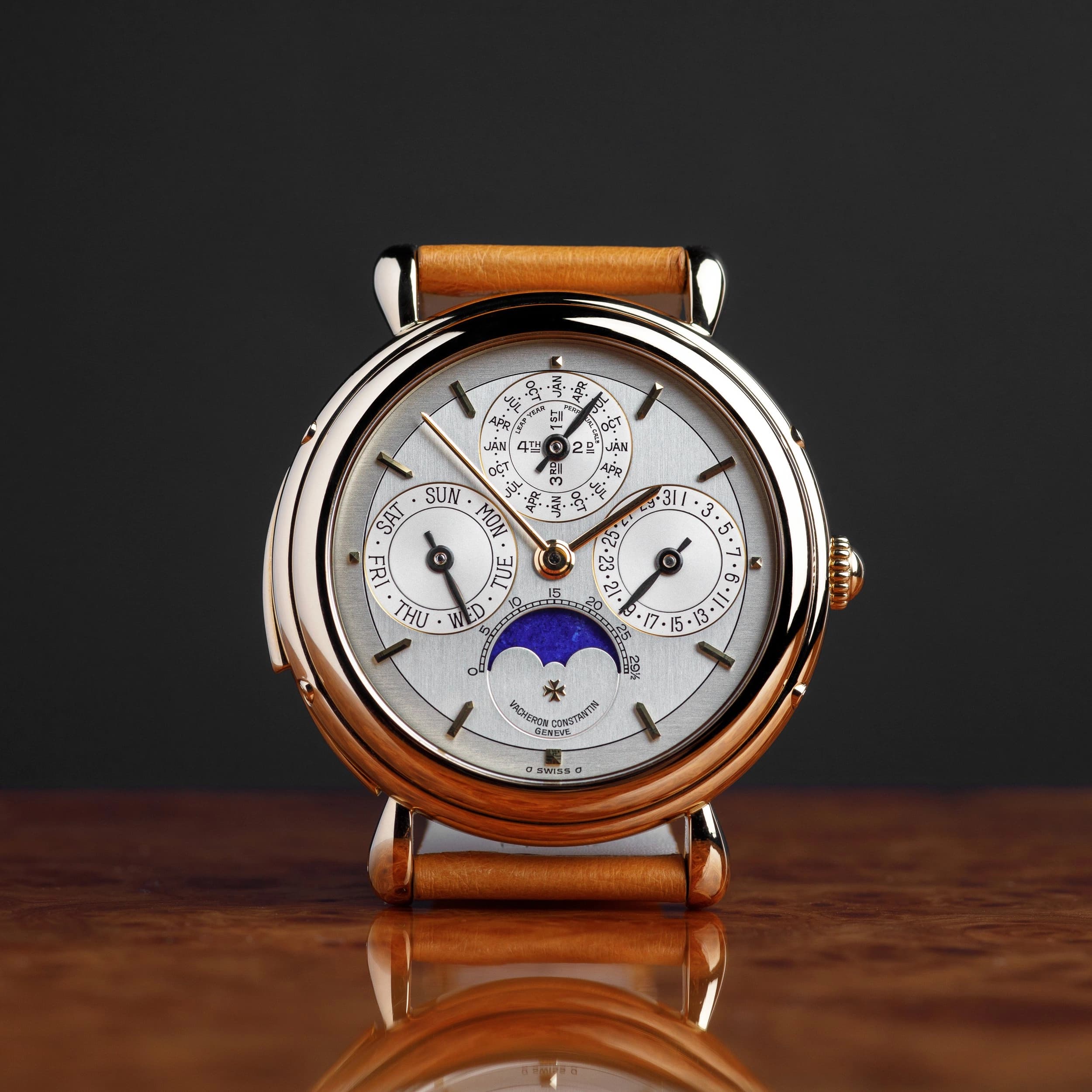
Patrimony Minute Repeater Perpetual Calendar
The result is asymmetric information. A buyer shopping a Patek Calatrava can find a dozen recent sales across condition grades before calling a dealer. A buyer shopping a Patrimony contemporaine automatic may find retail prices, a few forum posts, and a handful of listings with no clear throughline. That asymmetry benefits informed dealers and patient sellers. It does not benefit the buyer who is about to spend $15,000.
A second factor: Vacheron's production volume is lower than many buyers assume. The manufacture produces between 25,000 and 35,000 watches annually, putting it broadly below Patek Philippe, which targeted approximately 72,000 pieces in 2025. Fewer watches in circulation means fewer secondary market transactions, which means fewer data points, which means thinner price discovery. Lange makes this problem starker: at roughly 5,000 pieces per year, their secondary market is genuinely thin across most references. Vacheron is not that illiquid, but it is not Patek either.
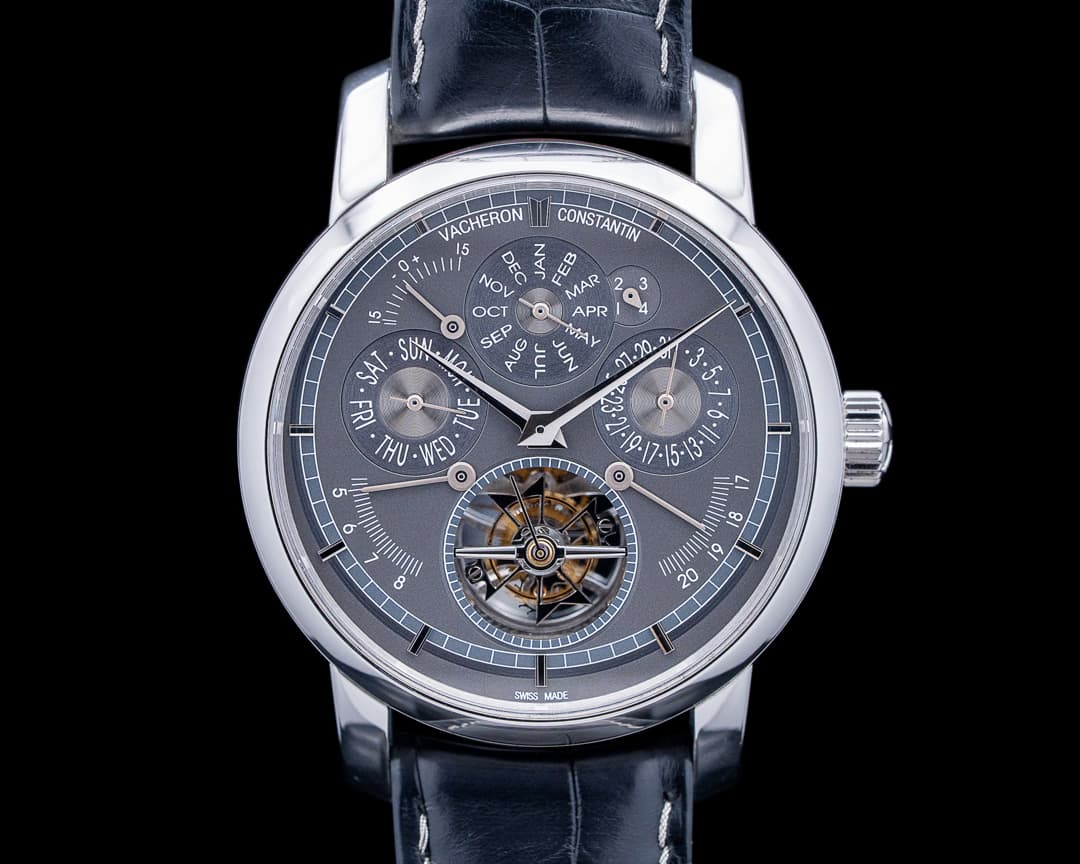
None of this means Vacheron is a bad buy. It means the buyer has to do more work, or find a dealer who has already done it.
How Vacheron Holds Value: The Honest Framework
The short version: the Overseas holds better than most buyers expect, Patrimony holds worse than many buyers assume, and Historiques is reference-dependent in ways that matter.
Across Overseas and Patrimony references, secondary market data suggests Vacheron trades at 60-75% of retail on average, a figure from dealer-composite analysis that skews toward the Overseas line, where data is denser. That range is directional rather than precise; no cross-brand appraisal study exists that tracks Vacheron, Patek, and Lange with matching methodology. What we see in actual transactions is consistent with that range for Patrimony, and somewhat better than that for clean Overseas steel examples, which have traded above retail in recent years.
Compare that to Patek: a clean Calatrava in steel rarely drops below 80-85% of retail in normal market conditions, and the Nautilus and Aquanaut have traded well above retail during peak periods. Lange occupies a different position. The secondary market is thin enough that "value retention" is partly an illusion of illiquidity. A Lange 1 may hold price because few people are selling, not because buyers are competing, though this is rapidly changing. That distinction matters if you ever need to exit.
Several structural factors shape Vacheron's position. Distribution is tighter than many buyers realize, boutique-heavy and with fewer authorized dealers than Patek's broader network, which limits new-watch availability and in theory supports used prices. Complication depth varies sharply across the catalog: the Overseas is primarily a three-hander or small-complication line, while the Traditionnelle and Historiques carry the serious complications, which tend to be illiquid regardless of brand. And since November 2024, Vacheron has operated a Certified Pre-Owned program through Watchfinder, which carries a minimum two-year warranty and a blockchain-backed digital passport for each piece. The program is real and recent; its effect on independent dealer pricing is not yet quantified, but CPO programs at comparable brands have historically commanded a 5-10% premium over equivalent-condition independent sales. Treat that as a reasonable inference, not a researched number.
The Overseas: What Clean Examples Actually Trade For
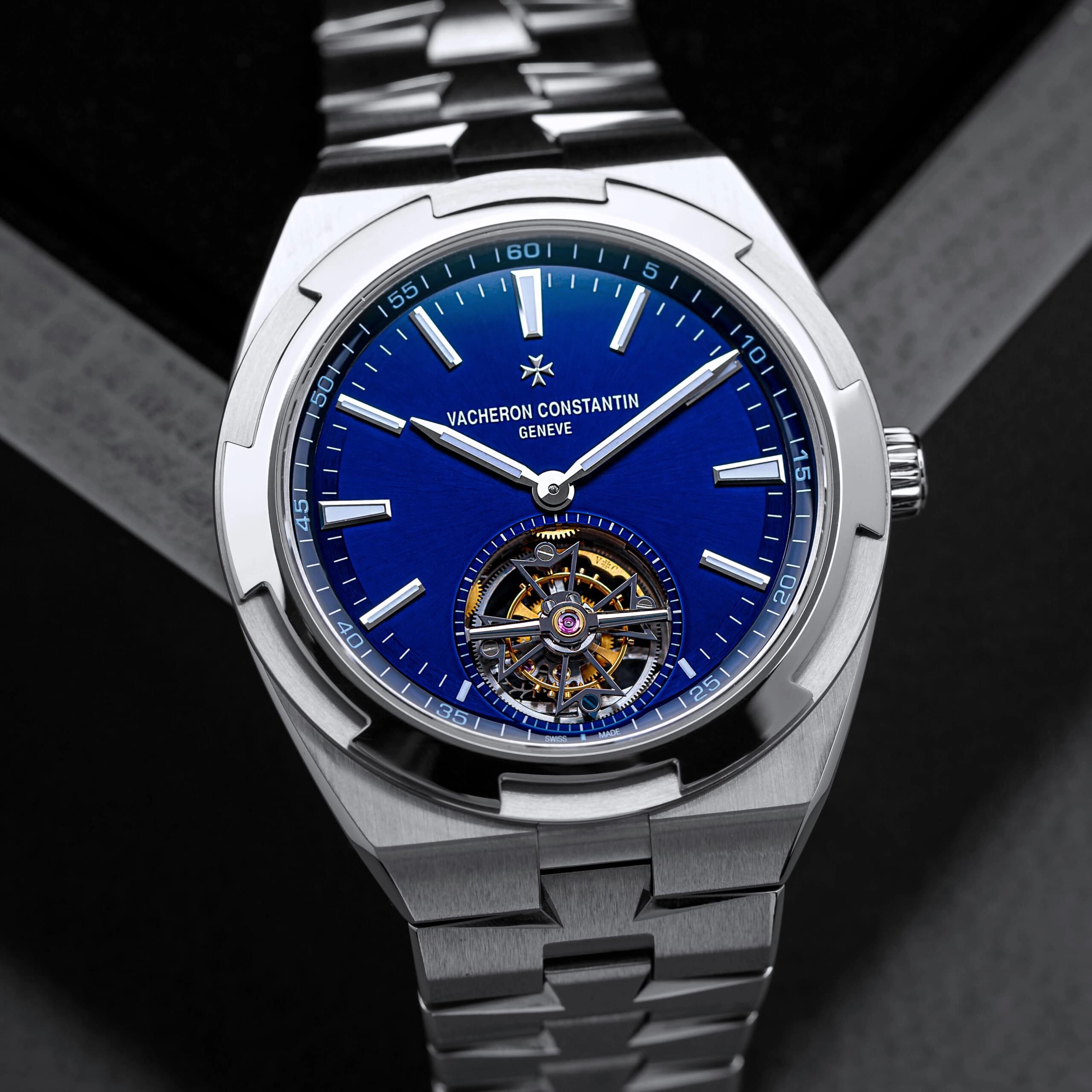
The Overseas is where serious pre-owned Vacheron starts. It dominates the brand's secondary market to a degree most buyers don't appreciate, roughly 80% of Vacheron's secondary market index by trading volume, per our data. If you want reliable price discovery in this catalog, this is where you find it.
Overseas 4500V (41mm, steel, three-hand)
The 4500V is the reference buyers mean when they say "Overseas." Introduced in 2016, it replaced the 49150 generation and brought integrated bracelet design, the interchangeable strap system, and a cleaner integrated lug structure. At retail, the steel blue-dial version has been priced around $25,000 in recent years.
On the secondary market, clean steel 4500V examples in collector-grade condition, complete three-piece set (metal bracelet, rubber strap, leather strap), original box and papers, no polishing, have traded at $30,000-$33,000, representing a 15-25% premium above retail. That premium reflects genuine secondary demand and limited authorized dealer inventory rather than speculative buying. Blue dials carry a consistent 10-15% premium over silver and black equivalents, consistently enough that the color choice at purchase is worth thinking about if resale is a consideration.
Worn-but-honest examples, the watch has been worn regularly, the bracelet shows stretch and clasp wear, the strap set is incomplete, no box, come in lower, typically $24,000-$27,000 depending on dial condition and whether the case shows polishing. Project-condition examples, meaning heavy case polishing, an incomplete strap set, and no documentation, should be bought with a service cost in mind; figure $22,000-$24,000 for the watch and budget appropriately for a full service.
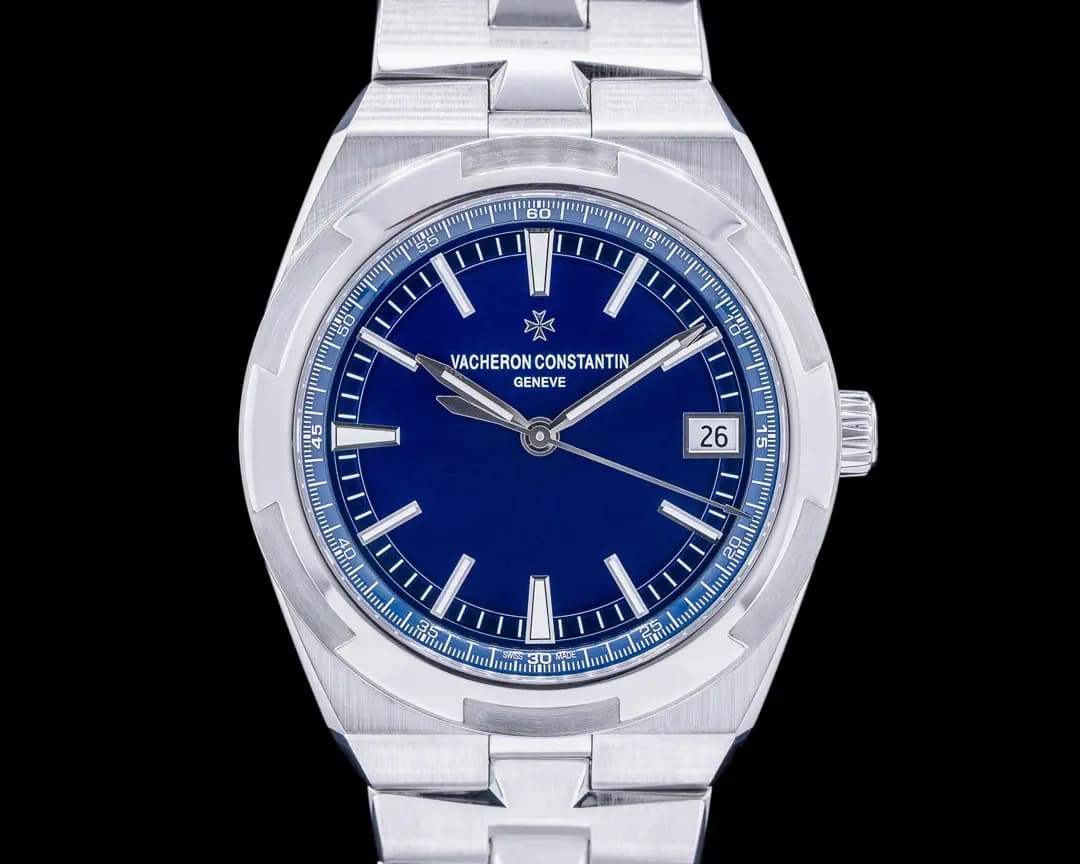
Vacheron Overseas 4500V
The lug-and-link wear issue deserves specific attention because buyers routinely underestimate it. The Overseas bracelet is beautifully integrated but not bulletproof: the links between the case and the first bracelet section are where wear concentrates first, and replacing those links through Vacheron's service network is not cheap. When evaluating a used 4500V, pay close attention to the play in the bracelet at the lug join. Moderate stretch across the full bracelet is normal and doesn't dramatically compress price. Visible wear at the lug interface, or a bracelet that has been improperly tightened, is a different and more expensive problem. Ask to hold the bracelet at the clasp and flex it; excessive looseness is the tell.
The bracelet itself is one of the things the Overseas does genuinely well. It sits flat against the wrist in a way that the Nautilus and the Royal Oak do not always manage, conforming without riding up at the deployment clasp. The 41mm case wears close to the wrist and reads slightly smaller than the spec suggests; a fair number of buyers who try one on expecting something aggressive find it surprisingly composed.
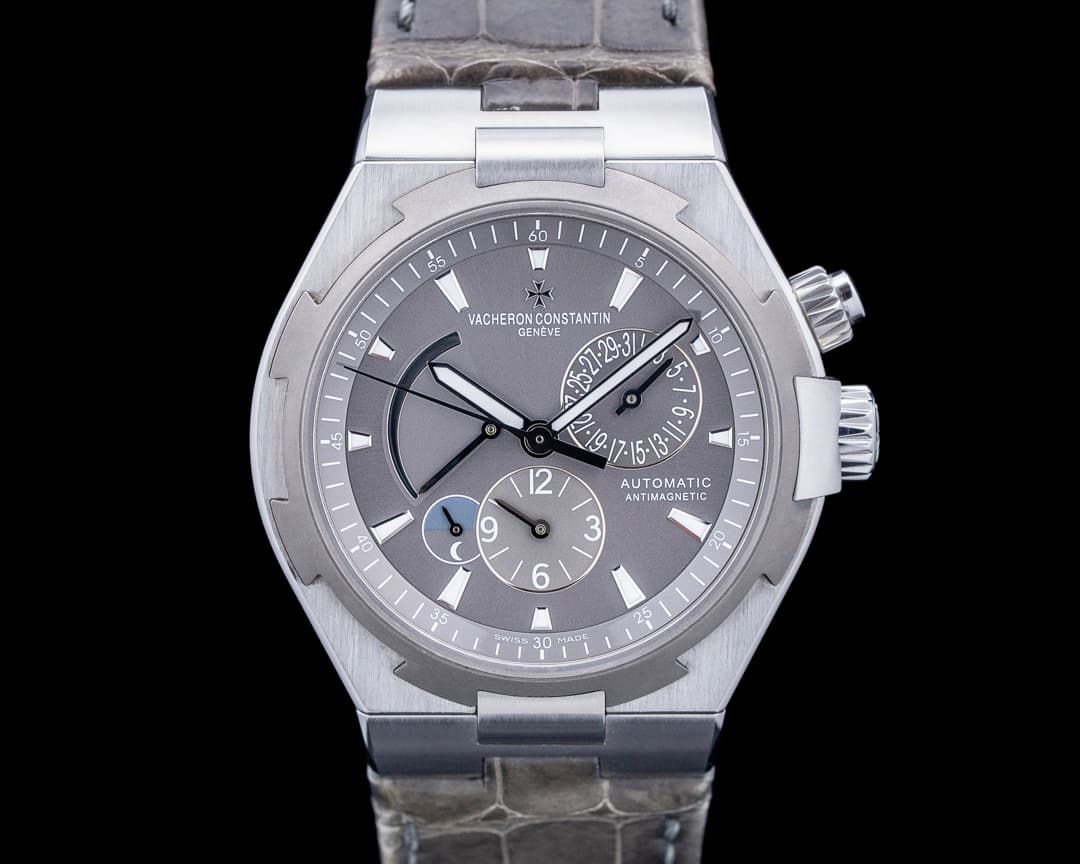
Overseas 7900V Dual Time (41mm, steel, automatic)
The Dual Time is a quieter proposition, same family, meaningfully different character. The case is more substantial, the dial adds the dual time functionality, and the bracelet is proportioned accordingly. Secondary market data for this reference is thinner than for the 4500V. Clean examples have sold in the $22,000-$28,000 range, with the lower end representing worn examples without documentation and the upper end reflecting complete-set, near-new condition. The reference has not generated the consistent above-retail premiums of the standard 4500V, which makes it interesting for a buyer who wants the Overseas aesthetic with slightly less demand pressure. The earlier variant of the 7900V is the 47450 shown below at a discount from the 7900 pricing.
Overseas 5500V Chronograph (42.5mm, steel)
The 5500V is the Overseas complication play. The case is larger, 42.5mm reads noticeably bigger on the wrist than the 4500V, and the movement adds a column-wheel flyback chronograph to the three-piece strap system. Retail on these has run north of $30,000 in recent years.
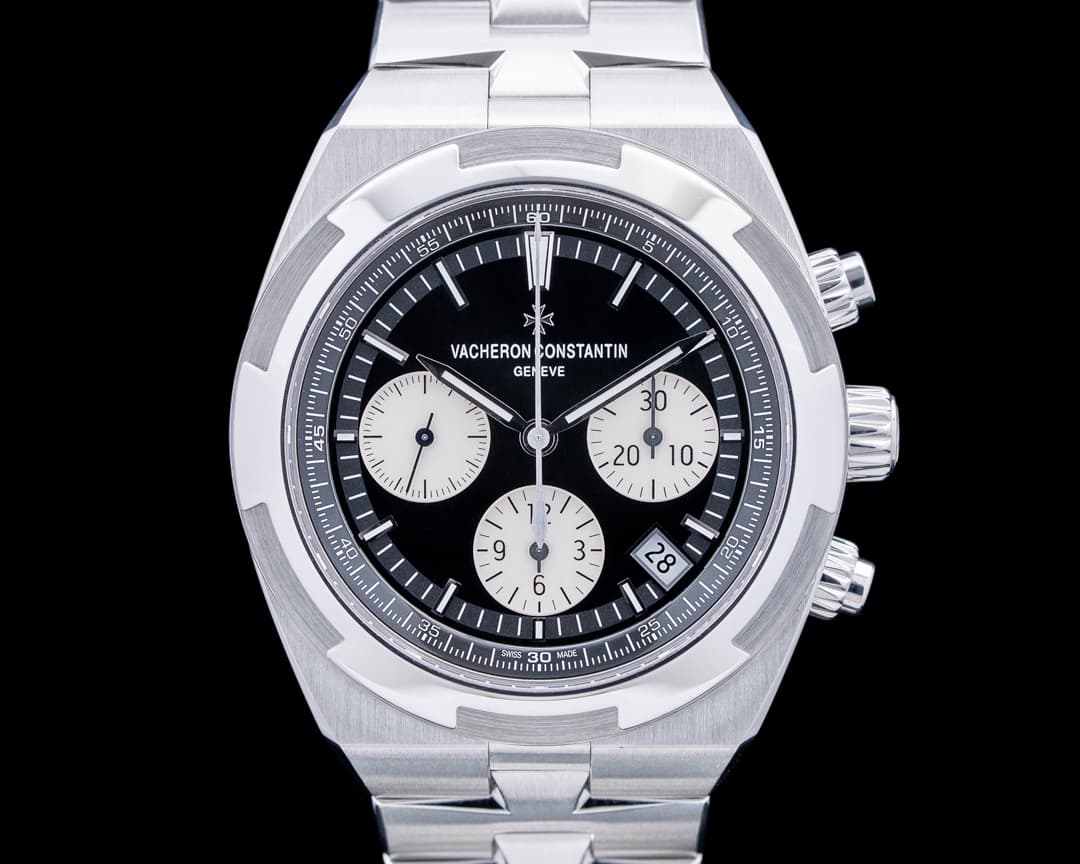
Pre-owned 5500V chronographs in clean condition have traded in the $28,000-$35,000 range. Condition matters more here for two reasons: the larger case surface means polishing is more visible and more consequential, and the chronograph pushers are wear points that buyers should examine carefully. A pusher that feels gritty or uncertain suggests the chronograph mechanism needs service, budget accordingly and negotiate the price down before agreeing. Complete examples with the three-piece strap set command a premium; single-strap examples should be priced accordingly.
The Patrimony: Dress Watch Pricing and the Simplicity Premium
The Patrimony is where Vacheron's argument about restraint lives. The case is typically 40mm, slim enough to disappear under a shirt cuff, and the dial is as close to nothing as a watch dial gets: applied indices, dauphine hands, and space. Rarely a date, no crown guards, no texture. The simplicity is not an absence of decision. It is the decision, made repeatedly and held.
Buyers who find this compelling pay for it. That is the first pricing truth about the Patrimony: it sells at a premium to what the spec sheet would predict, because the people who want it want it specifically and are not cross-shopping it against the Overseas or . The buyer for a Patrimony in yellow gold with a blue dial is not the same buyer considering an Overseas chronograph. They are different markets with different logic.
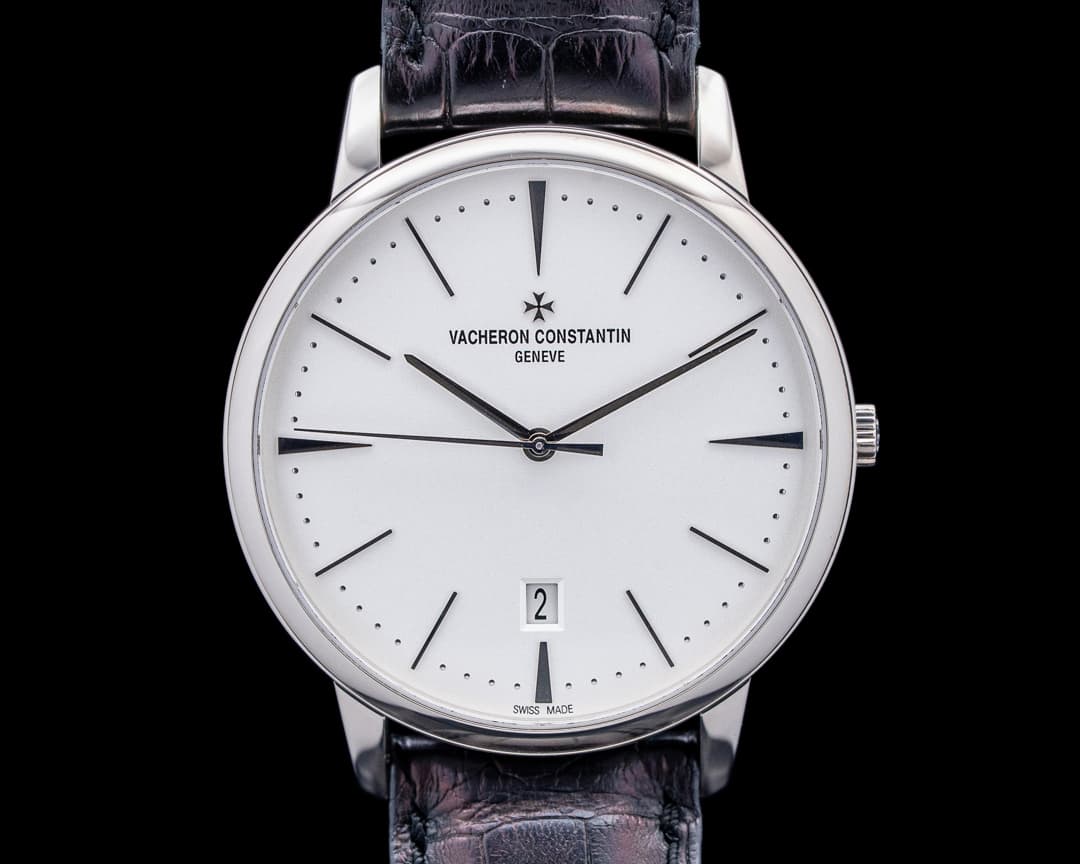
The second pricing truth is harder. Patrimony and Traditionnelle references trade below retail for most configurations, and the secondary market in Patrimony is not deep enough to generate the kind of clean comp stacks that exist for the 4500V. What dealer experience and available listing data support is that a typical pre-owned Patrimony contemporaine automatic in steel or rose gold, in honest worn condition, will trade somewhere in the 65-75% of retail range. That means a watch that retailed around $18,000-$22,000 will often clear at $13,000-$16,000 in the secondary market, and a complete set in near-new condition might approach $16,000-$17,000.
That is a significant discount from retail, and it requires an honest acknowledgment: the Patrimony is not a value-hold purchase. Buyers who expect it to behave like the Overseas will be disappointed if they check the secondary market a few years after buying. Buyers who understand they are paying for a dress watch that does its job with uncommon precision, and who intend to wear it, not resell it, are making a coherent choice. The Patrimony is the classic standard for a simple dress watch.
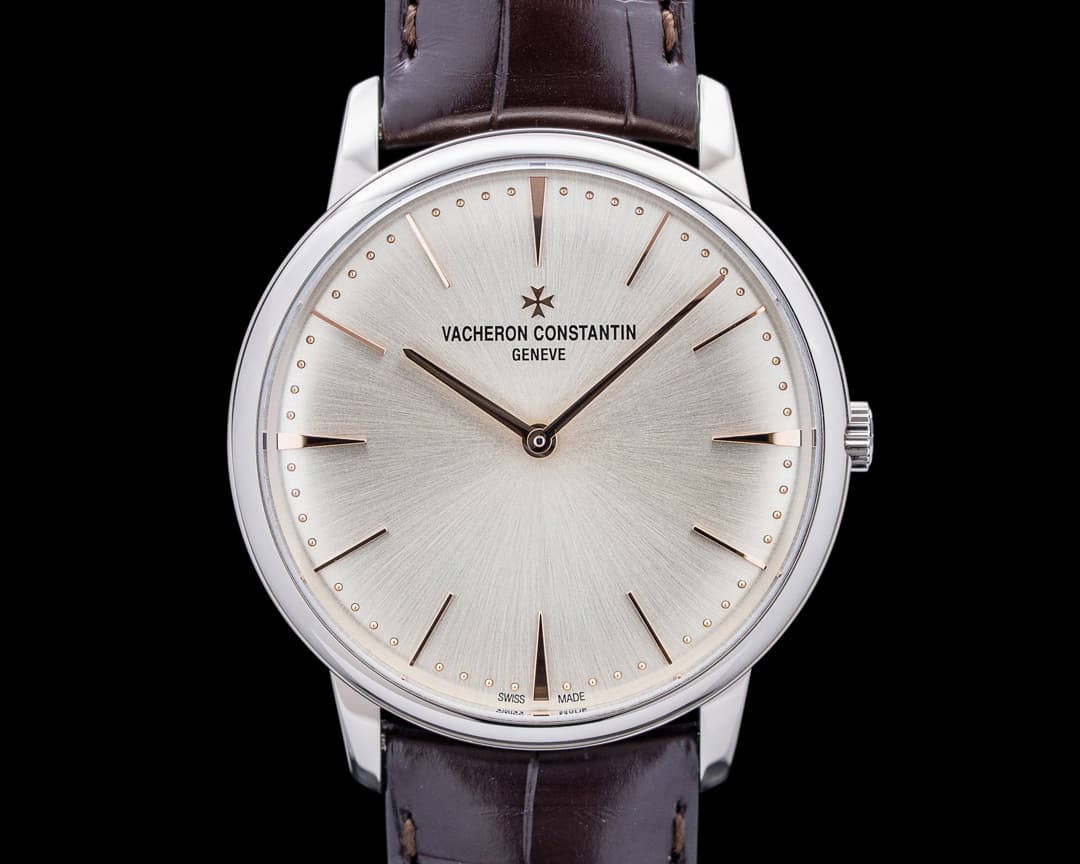
The manual-wind Patrimony references carry slightly more collector interest than the automatic variants, but the secondary market for both is thin enough that generalizing with confidence is difficult. If you are buying a specific Patrimony reference and want to know what it will fetch, the honest answer is: find two or three recent sold listings across platforms, apply a 5-10% haircut for dealer margin, and you are probably close. Do not rely on asking prices, which tend to be optimistic.
The Patrimony's slim profile, it wears like a dress watch should, sitting low and flat, is not incidental. It is the point. Anyone who picks it up next to an Overseas will understand immediately that they are solving different problems for different customers and thriving in each respective category.
The Historiques: Complications, Cult Appeal, and Where the Market Thins
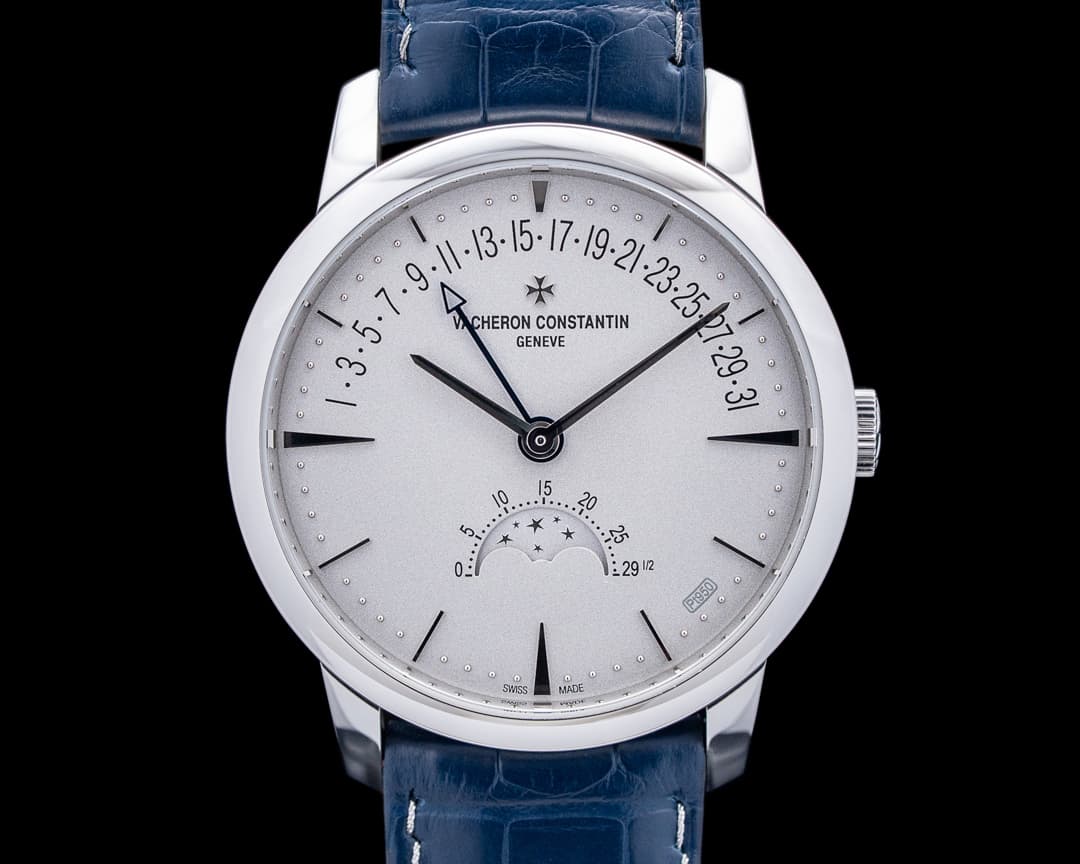
The Historiques line is Vacheron's argument for its own history: reissues, tributes, and interpretations of the brand's design archive. It produces some of the most interesting-looking Vacheron references and also some of the thinnest secondary markets. These two facts are related. High design specificity appeals to a narrow audience, and narrow audiences mean fewer transactions. To match, typically Vacheron makes fewer of these pieces.
American 1921 (ref. 82035)
The American 1921 is the reference with the most established secondary market within Historiques. Its tilted dial and off-center crown are either exactly right or entirely wrong depending on the buyer, which means it has a defined audience rather than a broad one, and that audience is willing to pay for it. Dealer listings for the ref. 82035/000R-9359 in rose gold range from approximately $23,000 to $39,900, depending on condition and production year. The width of that range reflects genuine condition variation rather than market confusion.
Clean rose gold examples in excellent condition with documentation have supported the upper portion of that range. Worn examples without papers have landed closer to the lower end.
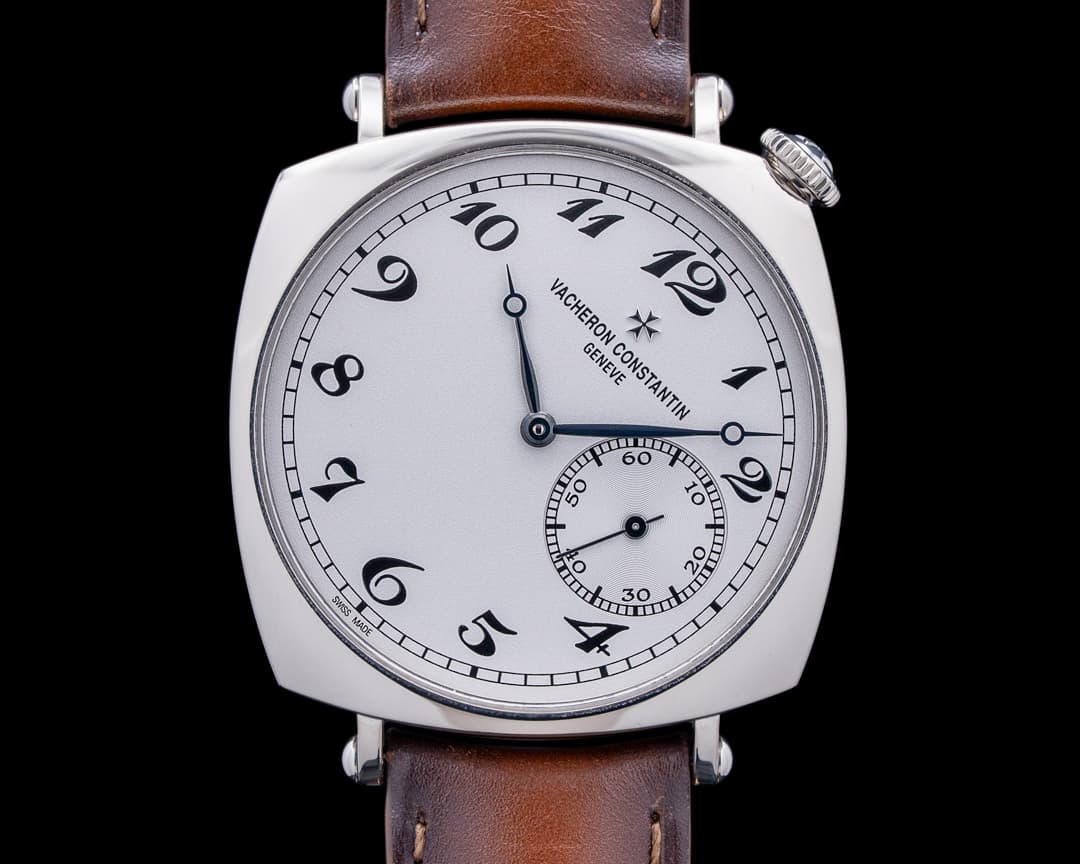
The watch wears differently than it reads on paper. The tilted dial is not a gimmick once you've put it on; the positioning actually improves legibility for a watch worn on the left wrist. The case is 40mm or 36.5mm, relatively slim, and the crown placement reinforces the asymmetric composition. It is not for everyone but its eccentricity earns it consumers that love something a little different. Vacheron recently updated the collection, and we'll need to wait to see how preowned prices sit after the first examples hit the secondary market.
Triple Calendrier and Other Historiques References
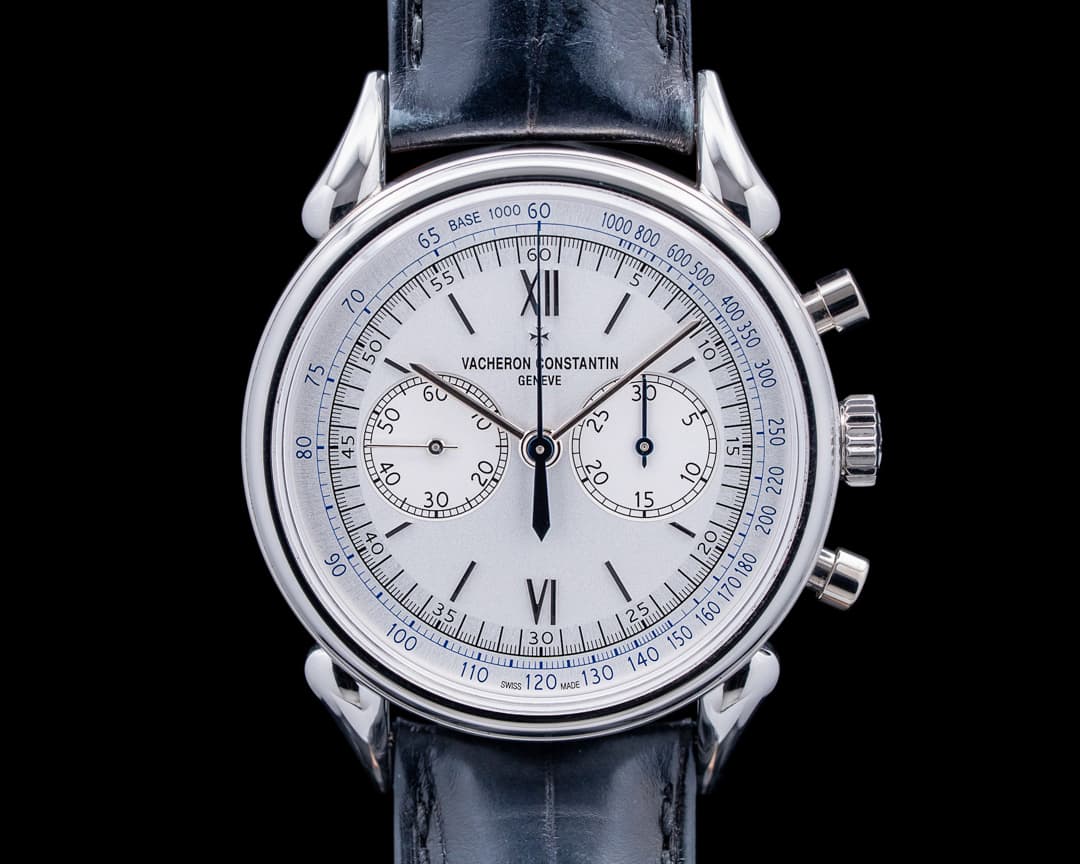
The Triple Calendrier (ref. 4010T/000R and related) has attracted collector attention and does trade in the secondary market, but volume is thin enough that citing specific ranges with confidence is not possible from available data. EWC has had these pieces in the mid 30,000 dollar range typically based on our sell side data and past reference points.
For Historiques references outside the American 1921, treat thin trading volume as a structural feature, not a temporary condition. A watch that trades infrequently is not necessarily mispriced, but illiquidity means that when you want to exit, your buyer pool is small and your timeline may be long. That is not always a problem. A buyer who intends to hold a Historiques complication for a decade is making a different calculation than one who wants a liquid asset. Know which buyer you are before committing.
The rule of thumb: if you cannot find at least four or five independent sold listings, not asking prices, for a reference, you are in thin market territory. A wider bid-ask spread is fair compensation for taking on that illiquidity risk. Price accordingly.
Vacheron vs. Patek vs. Lange: A Dealer's Honest Comparison
At three price bands, here is what the pre-owned market actually offers from each brand, and what you are buying in each case.
$10,000-$15,000
At this level, Vacheron primarily offers entry-point Patrimony contemporaine pieces: manual-wind or automatic, steel or earlier rose gold configurations, worn condition. These are real watches that do their job beautifully, but secondary liquidity is limited and condition premiums are compressed. You are buying the watch to wear it.
Patek at this level offers vintage Calatrava references: older generations, worn condition, possibly polished cases. The Calatrava is a more liquid asset than the Patrimony, with more buyers, more comps, and faster resale if needed. Service network access through authorized dealers is broadly comparable between the brands at this price.
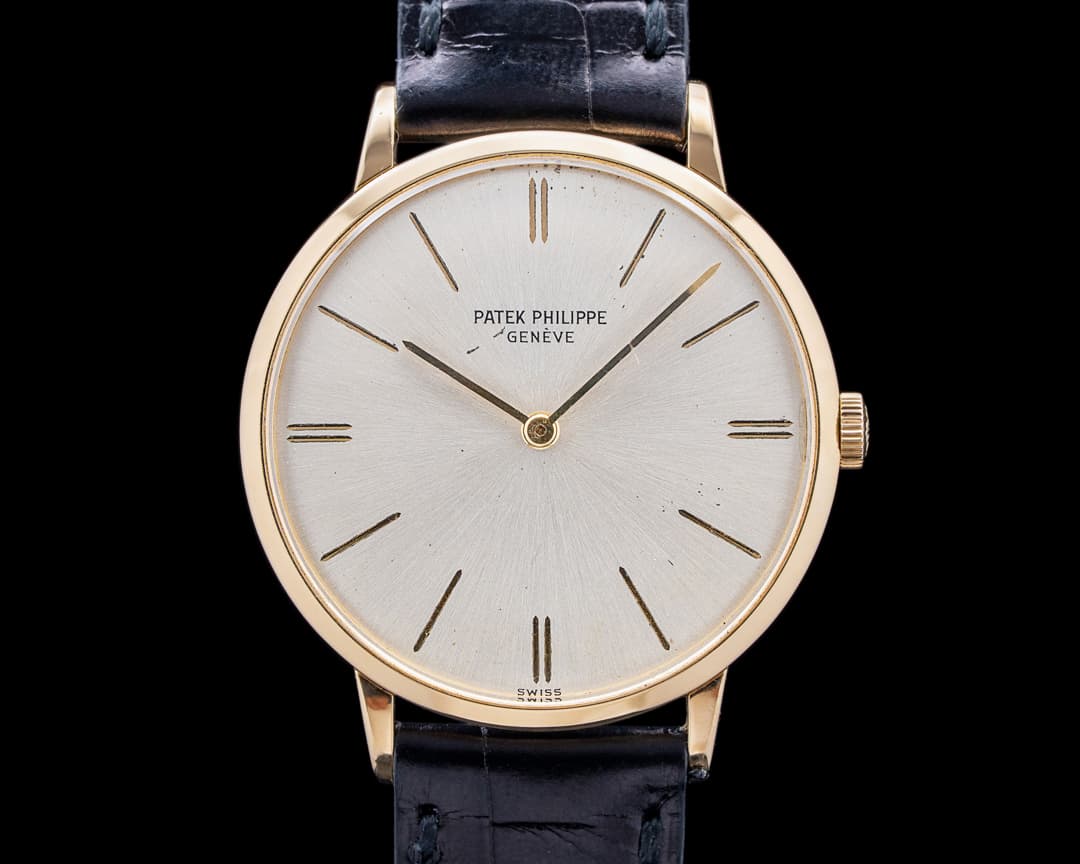
Lange at this level is thin. The entry is higher, and $10,000-$15,000 buys a worn example from an older generation Saxonia at best, with limited service history data available. The brand's retail floor pushes buyers upward.
$20,000-$30,000
This is where Vacheron is most competitive. The Overseas 4500V in steel, in honest worn condition, sits squarely in this range. The watch is liquid by Vacheron standards, it wears well, and it holds value better than most Vacheron references. Blue-dial examples with complete strap sets in the $27,000-$30,000 range are fair market for 2024-2025 conditions. The Overseas steel has outperformed its retail price in recent years, which is worth noting when comparing to Patrimony. This is also a more accessible pricing than the equivalent watches from Patek, which (in the Nautilus collection) trade at a multiple of the value of the Overseas.
Patek at $20,000-$30,000 offers clean Calatrava references in steel or early complications: annual calendar references from earlier generations if lucky. These are more liquid assets with a deeper buyer pool. If resale speed matters, Patek wins the comparison at this level. If the watch itself matters more than exit optionality, the Overseas is extremely strong competition.
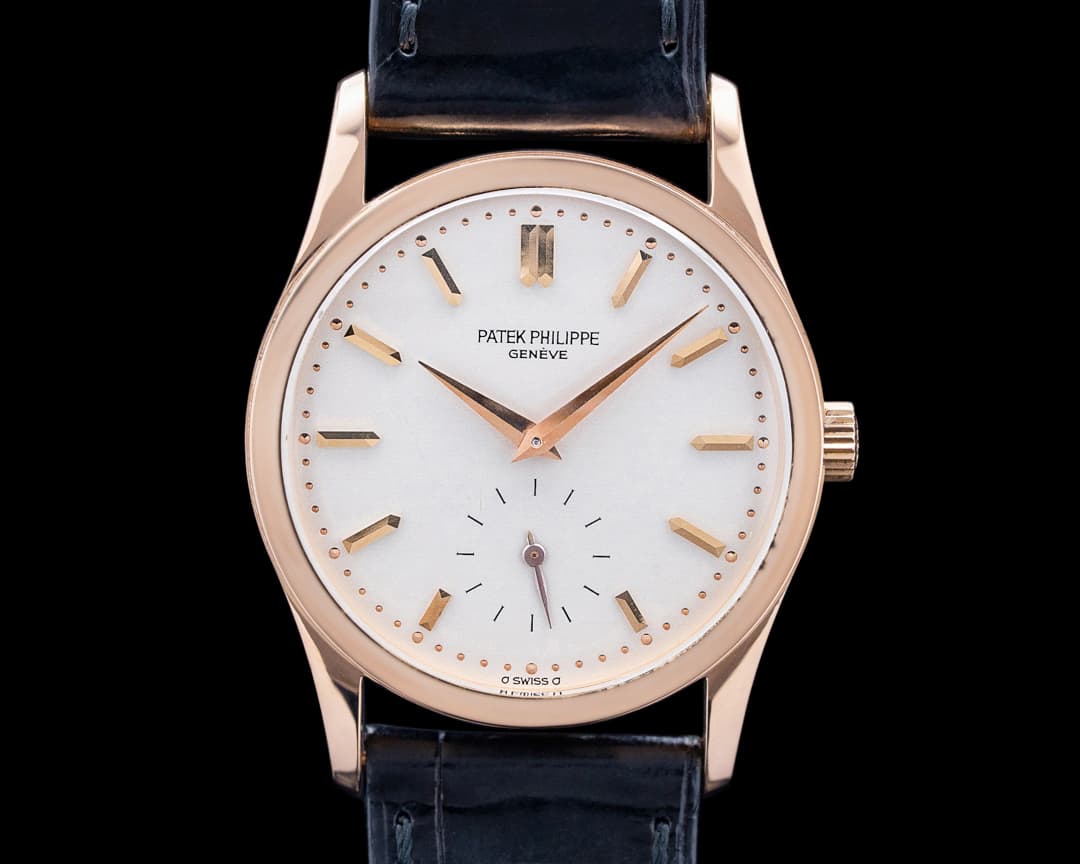
Lange at $20,000-$30,000 starts to open up: Saxonia Thin references, entry Lange 1 pieces in worn condition, 1815 pieces. These are thinner markets than either Vacheron or Patek, but the quality of the movement finishing is a genuine differentiator. Buying a Lange at this price and holding it is reasonable.
$35,000-$60,000
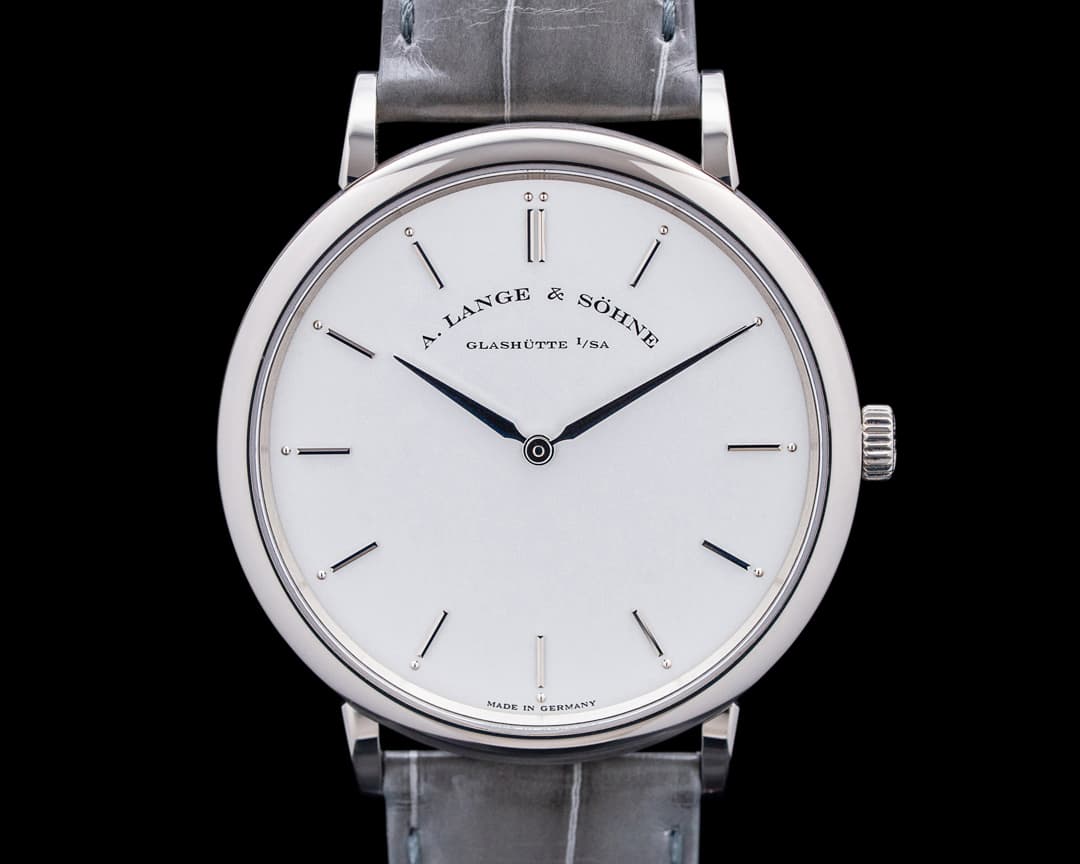
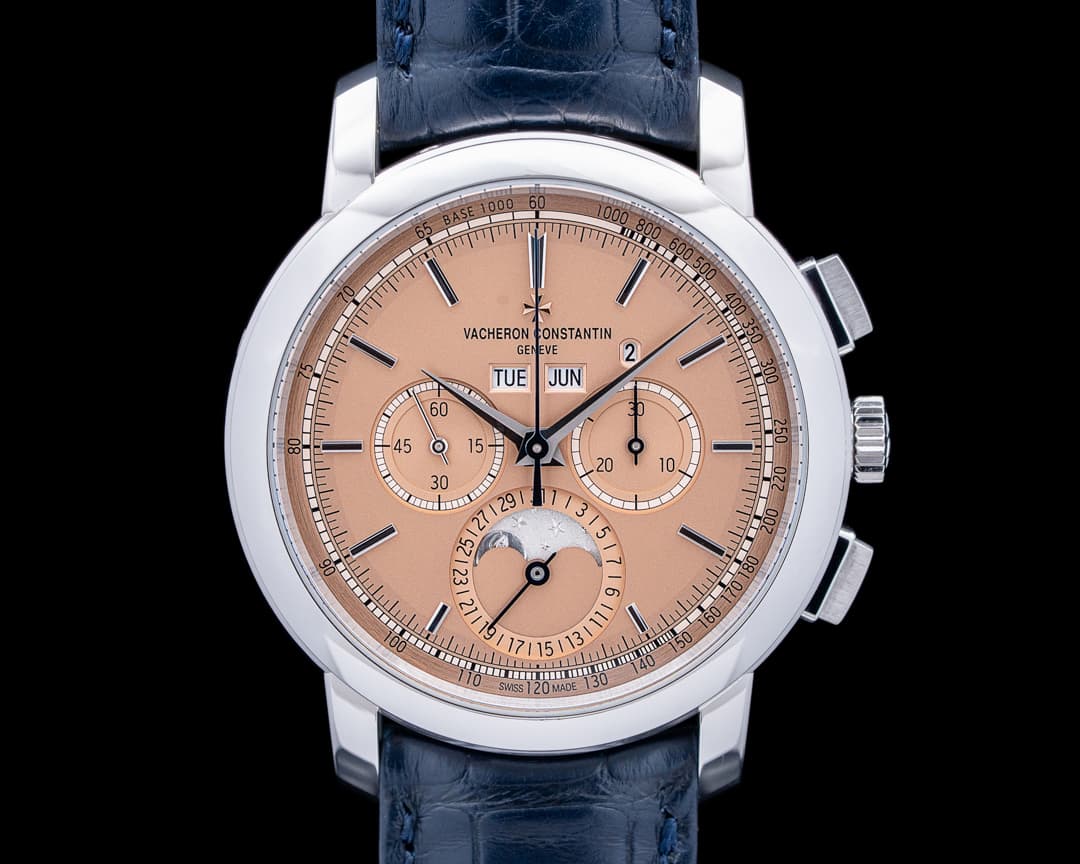
Vacheron at this level means Overseas in precious metal, Overseas Chronograph in clean condition, or Historiques models in the American 1921 range, Cornes de Vache Chronographs, and more. The precious metal Overseas trades less predictably than the steel, fewer buyers, wider spread. The chronograph is a specific-use piece with a smaller audience. These are watches you buy because you want them, not because you expect them to outperform. They are also great values compared to equivalents from competitor brands.
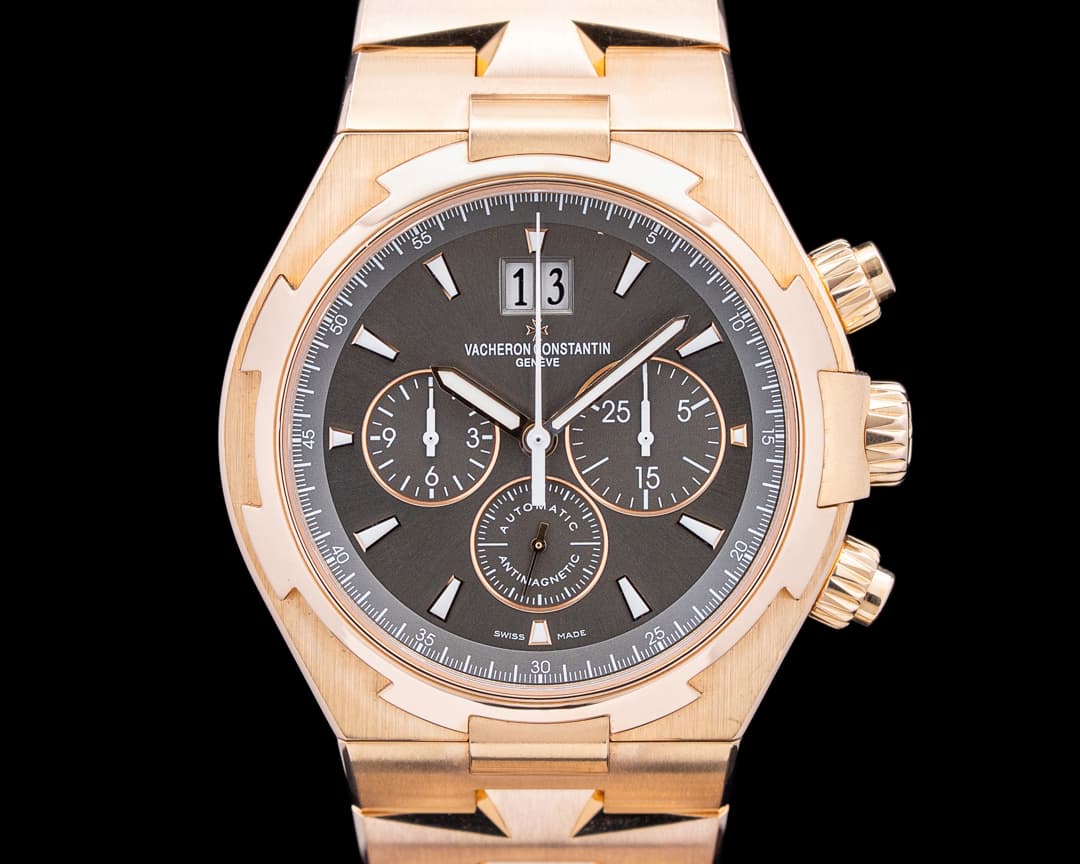
Patek at $35,000-$60,000 is where the conversation changes materially. Annual calendar and perpetual calendar references land in this range: complications with established secondary markets, documented service histories available through authorized dealers, and resale speed that Vacheron cannot match. The parts availability question matters at this price. Patek's service network is larger, and the parts pipeline for older complications is more reliable.
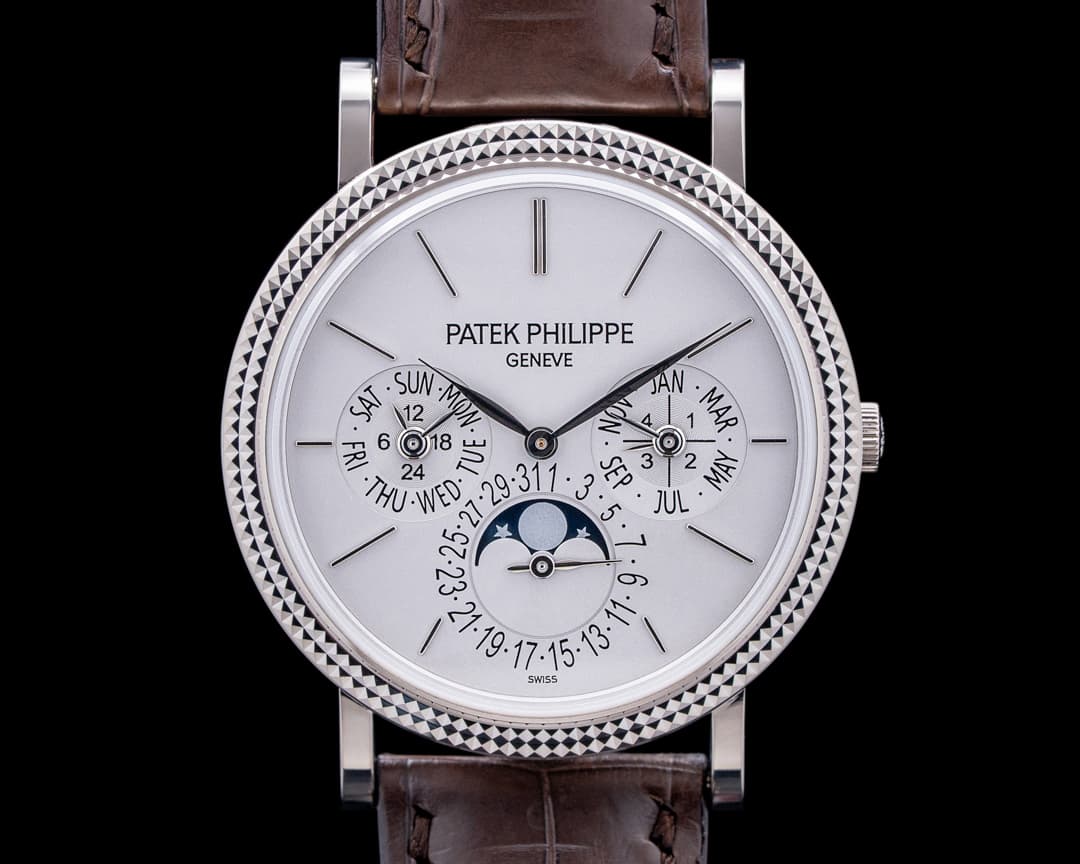
Lange at $35,000-$60,000 gets serious: Lange 1 in solid condition, older chronographs, complicated Lange 1s and more. Like before, the finishing argument is strongest here, and buyers who care about movement decoration will find the case compelling. But thin market conditions persist; exits can take time, and realized prices can disappoint if the timing is wrong.
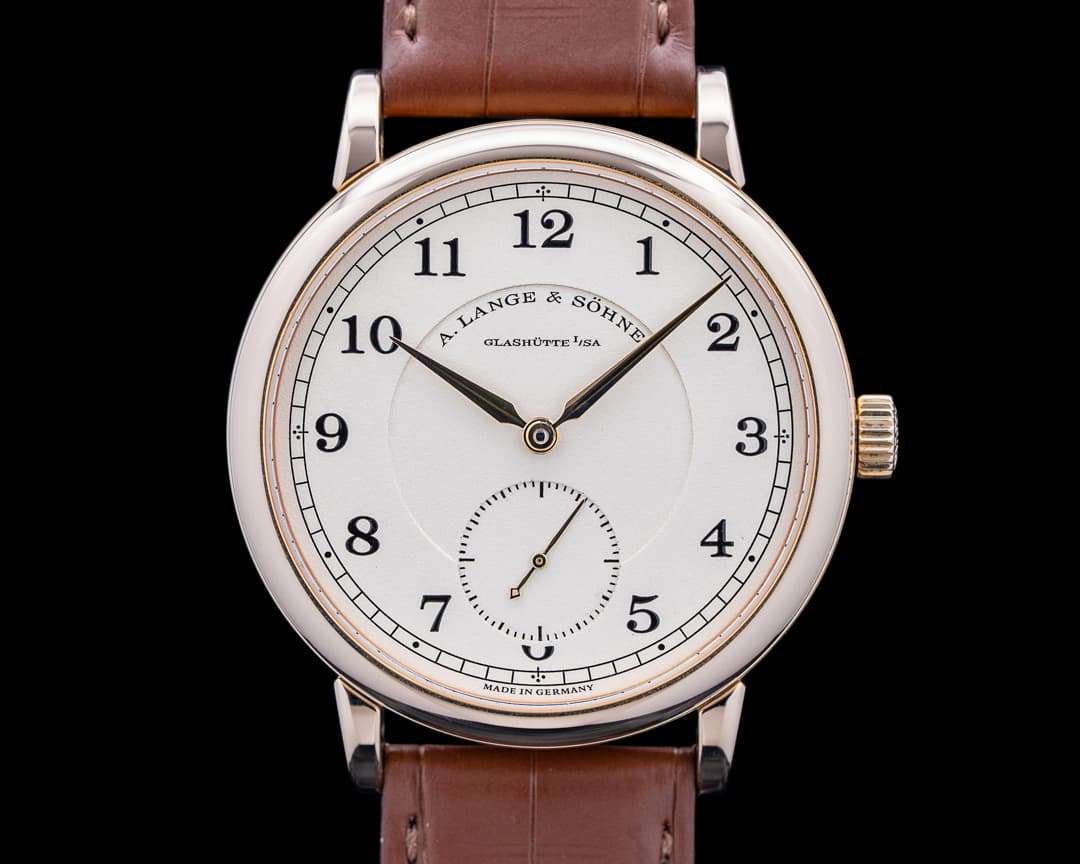
The honest summary: Vacheron affords an incredible value at each bracket relative to the competition. Patek has a structural liquidity advantage across most price bands. Lange is for buyers who care more about the object than the exit. These are not rankings. They are characterizations of what you are actually buying.
What to Pay, What to Walk Away From
Condition flags specific to Vacheron
Start with the case. Vacheron's multi-surface finishing, particularly on the Overseas, which combines brushed and polished facets, is among the most difficult to restore correctly. An over-polished Overseas loses the crisp transitions between surfaces, and the result is visible to anyone who has handled a clean example: rounded edges, flat-looking lugs, a loss of definition at the case middle. This is not a minor aesthetic point. It is a significant deduction from value and a persistent one, since refinishing to factory spec through authorized service is expensive. Walk away from an Overseas with badly polished surfaces unless the price reflects full refinishing cost.
On bracelets: as noted in the Overseas section, lug wear is a specific point of failure. Beyond that, examine the clasp for deep scoring and the inner bracelet surface for stretching. A bracelet that has been worn hard will have links that flex more than they should. Factor the cost of bracelet refurbishment or replacement into any negotiation.
Dial condition matters disproportionately at Vacheron prices. Moisture intrusion, hairline scratches on applied indices, and on the Patrimony especially, any clouding or spotting on the dial surface are serious defects that compress realized price. Examine the dial under a loupe and under raking light.
The service history conversation
Vacheron movements require manufacturer-trained service. Vacheron's service interval recommendation is approximately five to seven years for most references, and a full service through an authorized center runs several thousand dollars depending on the reference and complication level. When evaluating a used Vacheron, the service history conversation is not optional: ask for documentation, understand when the last service occurred and who performed it, and factor the cost of an overdue service into your offer.
Where the market is heating versus cooling
Steel Overseas, particularly the 4500V in blue dial, has been the most consistently demanded Vacheron reference in the secondary market over the past several years and continues to trade at or above retail for clean examples.
Patrimony is not heating. Secondary market interest in dress watches broadly has been soft since the pandemic-era correction, and Vacheron's slim-dress line has not been immune. Buyers can find patient sellers willing to move Patrimony references at reasonable discounts. That is good news if you want to wear one; it is not good news if you bought one expecting appreciation.
American 1921 in rose gold has sustained collector interest, but the price range is wide and condition sensitivity is high. Buy the best example you can find in your budget. The spread between a worn 1921 and a near-new one is not trivial.
On fair value versus overpay
The cleanest test: find three recent sold listings, not asking prices, across sales channels for the exact reference and condition grade you are considering. Average them. If the offer you're looking at is within 5% of that average for the same condition grade and documentation status, it is fair. If it is more than 10% above, ask why. A seller who can articulate the premium, complete three-piece strap set, full documentation, CPO certification, near-zero wear, is pricing correctly. A seller whose only answer is "Vacheron is a great brand" is selling hope, not a watch.
The secondary market for Vacheron Constantin is real, it is active in the Overseas line, and it has matured enough to support the kind of reference-level discipline buyers deserve. The information was thinner than it should have been. It doesn't have to stay that way. At EWC we've loved Vacheron for a while and are excited to see it receiving some deserved attention!
Shop New Arrivals
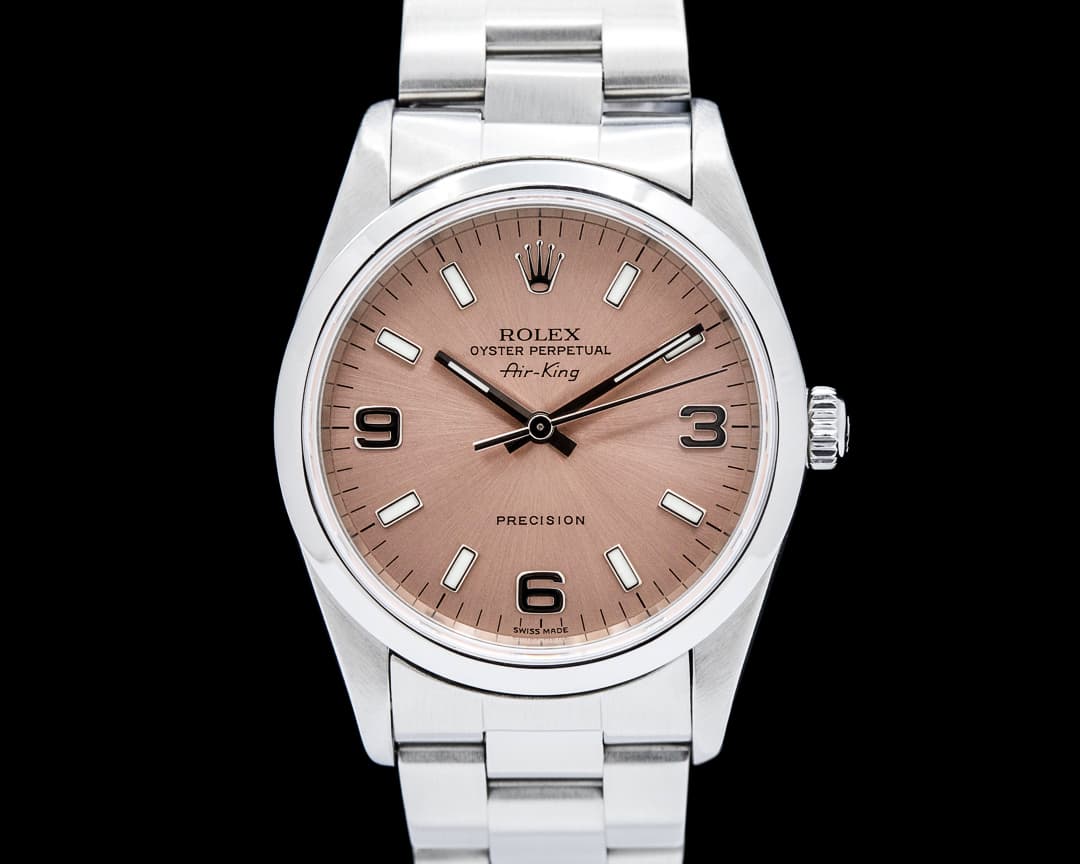
14000 Air King SS Salmon Dial
$5,750
View Watch
Speedmaster First Omega in Space SS Black Dial
$6,500
View Watch
WSTA0083 Tank Americaine Large SS Silver Dial 2026
$6,350
View Watch
3876.50.31 Speedmaster Professional Moonphase SS Black Dial
$7,350
View Watch
Shop New Arrivals
14000 Air King SS Salmon Dial
$5,750
View WatchSpeedmaster First Omega in Space SS Black Dial
$6,500
View WatchWSTA0083 Tank Americaine Large SS Silver Dial 2026
$6,350
View Watch3876.50.31 Speedmaster Professional Moonphase SS Black Dial
$7,350
View Watch
More Content